9 recommended American whiskeys at a glance
This selection covers all three US styles: six bourbons from the mild wheated bourbon to the aged classic, two rye whiskeys and one Tennessee whiskey. All are readily available in Germany. Prices are guide values for orientation, and the current price on the day may differ.
Advertisement: links to Amazon are affiliate links. If you buy through them, we earn a commission. The price you pay does not change.

Buffalo Trace
Buffalo Trace is the all-rounder with which you can hardly go wrong in American whiskey. On the nose vanilla, caramel and a delicate mint, on the palate caramel, oak and spice, plus a medium-length, sweet-spicy finish. At 40 percent it stays approachable, and if you are after a lot of punch and depth, you would rather reach for one of the stronger bottlings further down.

Wild Turkey 101
Wild Turkey 101 stands for 101 American proof, that is a robust 50.5 percent, and is still one of the cheapest whiskeys on this list. Vanilla, caramel and oak on the nose, robust and spicy on the palate, with a long, warm finish. Neat it is quite demanding for beginners, and a few drops of water take the sharpness back noticeably.

Maker's Mark
Maker's Mark is a wheated bourbon: instead of rye, wheat provides the spice, which makes it noticeably softer and rounder. Vanilla, caramel and oak shape nose and palate, and the finish stays medium-length and sweet. This very gentleness is also its limit, and if you are looking for peppery spice you will not find it here.

Jack Daniel's Old No. 7
Strictly speaking Jack Daniel's is not a bourbon but the best-known Tennessee whiskey: before cask maturation the distillate runs through charcoal made from sugar maple, known as charcoal mellowing. The result is soft and sweet, with vanilla, banana and caramel on the nose. In flavour rather simply built, but cheap and at home in a long drink.

Four Roses
Four Roses Bourbon is one of the most approachable entry points into American whiskey. Instead of heavy sweetness, light fruits such as apple and pear dominate, plus honey and blossom, with gentle spice and caramel on the palate. At 40 percent and with a light finish it is not a complex sipper, but an honest all-rounder for getting started.

Elijah Craig Small Batch
Elijah Craig Small Batch offers astonishing maturity and depth for its price. Honeycomb, cedarwood and orange marmalade on the nose, baked apple, cinnamon and cookie dough on the palate, nutmeg and charred oak in the finish. The 47 percent give plenty of structure, though neat they make it more robust than the mild entry-level bottles.

Bulleit 95 Rye
Bulleit 95 Rye is the classic entry into American rye whiskey and one of the most popular cocktail bases of all. Vanilla, oak and cinnamon on the nose, caramel, clove and honey on the palate, pepper, dry oak and pronounced rye spice in the finish. Neat it stays rather straightforward, and in a Manhattan or Old Fashioned it plays to its strength.

Rittenhouse Bottled-in-Bond
Rittenhouse is a bottled-in-bond rye, which by law means at least four years of maturation and exactly 50 percent alcohol. Vanilla, cocoa and liquorice on the nose, baking spices, toasted wood and toffee on the palate, clove, cinnamon and dry heat in the finish. A cocktail workhorse with plenty of spice, though neat considerably more demanding than a bourbon.
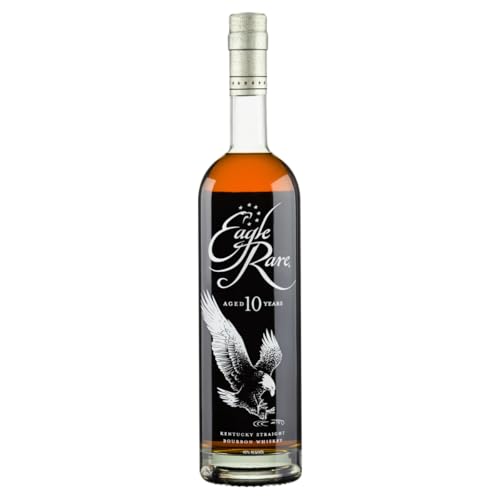
Eagle Rare 10
Eagle Rare from the house of Buffalo Trace carries an age statement of ten years, which is rare in bourbon. On the nose toffee, orange peel and leather, on the palate candied almonds, dark cocoa and dry oak, plus a dry, long finish with baking spices. The most elegant whiskey in this selection, though also by far the most expensive.
Bourbon, rye and Tennessee whiskey: the three big styles
American whiskey is almost always defined by its main grain, the so-called mash bill. This grain mix decides whether a bottle tastes sweet and full-bodied or dry and peppery. If you understand this one point, you can roughly gauge the character of a US bottle before the first sip.
Bourbon consists of at least 51 percent corn and therefore tastes sweet, with plenty of vanilla and caramel. Rye whiskey reverses the ratio: here rye makes up at least 51 percent, which makes bottles such as Bulleit 95 Rye noticeably spicier and drier. Tennessee whiskey meets the bourbon rules at its core but is filtered through charcoal before maturation, which is why Jack Daniel's seems especially soft.
In between lie hybrid forms. A wheated bourbon such as Maker's Mark replaces the rye with wheat and becomes rounder as a result, while a high-rye bourbon raises the rye share and approaches rye in flavour. The following overview summarises the differences.
| Style | Main grain | Character | Example from this list |
|---|---|---|---|
| Bourbon | at least 51% corn | sweet, vanilla, caramel | Buffalo Trace |
| Rye whiskey | at least 51% rye | spicy, dry, peppery | Bulleit 95 Rye |
| Tennessee whiskey | corn, charcoal-filtered | soft, sweet, round | Jack Daniel's |
| Wheated bourbon | corn with wheat instead of rye | especially soft and sweet | Maker's Mark |
The percentages refer to the grain mix before distillation, not to the finished whiskey. Within each style there are big differences, which are best tasted in direct comparison.
What defines American whiskey legally
The USA regulates its whiskey more strictly than many assume. Bourbon must be made in the United States, consist of at least 51 percent corn and mature in new, charred barrels of American oak. It is precisely these fresh barrels that supply the typical sweetness with vanilla and caramel, because each barrel gives up its aromas at full force only once.
Colourings are forbidden, and the strong amber colour arises in the wood alone. There is no minimum maturation for plain bourbon, however, which is why many well-known bottlings do without an age statement. What this means for quality is covered in the guide NAS versus age statement.
Two terms on the label help with the assessment. Straight means at least two years of maturation without additives, and under four years the age must be stated. Bottled-in-bond goes further: at least four years, a single distilling season at one distillery and exactly 50 percent alcohol, as with the Rittenhouse. Both are reliable quality anchors, not marketing phrases.
Value for money: where US whiskey is especially strong
American whiskey is among the categories with the best value for money of all. For approx. €16 you get a real powerhouse at 50.5 percent in Wild Turkey 101, which puts many considerably more expensive bottles in the shade. Jack Daniel's also sits in this price class.
In the middle range the choice is greatest. Here you find well-rounded all-rounders such as Buffalo Trace, the mature Elijah Craig Small Batch and the fruity Four Roses. Prices and profiles can be set side by side directly in the whisky comparison.
Things only get considerably more expensive with age statements and limited bottlings. The Eagle Rare 10 shows what ten years of cask maturation make, but costs approx. €58 against approx. €16 for a Wild Turkey 101. More money does not automatically mean more drinking pleasure, though, but mostly more complexity. A broader overview of the price classes is offered by our guide to the best whiskies under 50 euros.
Neat, on the rocks or in a cocktail
Mild bottlings such as Four Roses or Maker's Mark are best drunk neat at room temperature, and a bulbous glass bundles the sweet aromas. With robust bottles from 47 percent, a splash of water is worthwhile, which opens the aromas and takes the edge off the sharpness. You will find the basics in the guide How to drink whisky properly.
Hardly any whiskey family is as well suited to mixing as the American one. The Old Fashioned needs only whiskey, sugar, bitters and an orange twist, and the Manhattan adds red vermouth. Spicy ryes such as Rittenhouse hold their own particularly well here against sweet ingredients, and concrete recipes are collected in our guide to bourbon cocktails.
Ice is a matter of taste: it makes robust whiskeys more approachable but, as the temperature drops, also dampens the delicate aromas. For everyday use a simple rule of thumb applies: cheap, robust bottles are ideal mixing bases, while aged drops such as the Eagle Rare are better drunk neat. And regardless of that: enjoy whiskey consciously and in moderation.
Conclusion: which American whiskey suits you
For getting started, Four Roses and Maker's Mark are the safest bets, both soft and forgiving of mistakes in drinking. If you are looking for the classic all-rounder for every occasion, Buffalo Trace is right, and if you want a lot of character for little money, reach for Wild Turkey 101.
For cocktails the road leads to the rye whiskeys, above all Bulleit 95 Rye and the more robust Rittenhouse. If you want to work systematically through the American category, you will find more depth in our guides to the best bourbons and the best rye whiskeys. How US whiskey fares against Scotland is settled by the comparison bourbon versus Scotch.
If none of the nine suggestions fits your taste, our Whisky Finder helps you on in a few steps. Alternatively, browse straight through the whole bourbon and rye category.
Related guides
Transparency note: This guide was created with AI assistance and reviewed by our editors before publication. All recommended bottles come from our real catalogue, and prices are guide values. The product photos are not AI images. How we use AI