Four regions, four characters
To make the differences tangible, here are four typical representatives from four regions. That is the best way to taste for yourself how strongly origin shapes character.
Advertisement: links to Amazon are affiliate links. If you buy through them, we earn a commission. The price you pay does not change.

Laphroaig 10
A textbook example of the Islay style: robust peat smoke, plus iodine, seaweed and an unmistakably medicinal note. Laphroaig 10 polarises and is at the same time revered by smoke lovers. If you want to know what Islay stands for, try exactly this.
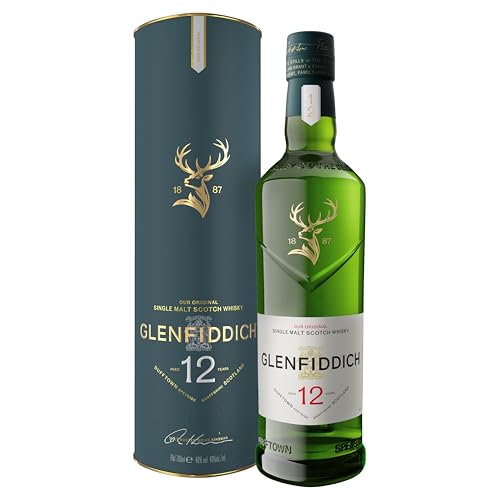
Glenfiddich 12
The best-selling single malt in the world and a model example for Speyside. Fruity with pear and apple, soft and elegant, entirely without smoke. This is how the approachable, fruit-led side of Scotland tastes.

Glenmorangie The Original 12
An elegant Highland malt with vanilla, citrus and fine florality. Glenmorangie shows how versatile the Highlands are, here of the light, gentle kind. Good proof that robust and smoky do not mean the same thing.

Talisker 10
This maritime malt comes from the Isle of Skye, with gentle smoke, pepper and a salty sea breeze. Talisker is exemplary of the character of the Islands, smoky but not as massive as an Islay. Spicy, lively and unmistakable.
Why the region shapes the whisky
The division of Scotland into whisky regions has grown historically and still serves as a guide today. Climate, water, proximity to the sea and above all local tradition shape the typical style of an area. That is how the idea arose that Islay tastes smoky and Speyside fruity.
What matters, though: this classification describes a tendency, not a strict rule. In almost every region there are distilleries that deliberately step out of line, such as unpeated malts on Islay or robust bottlings in the mild Lowlands. The region is a good first reference point, but not a law of taste.
Officially, five regions are distinguished, namely Highlands, Lowlands, Speyside, Islay and Campbeltown. The islands, often called the Islands, are formally usually counted as part of the Highlands but are often considered separately because of their own maritime character. The following table gives you a quick overview.
| Region | Typical character | Example |
|---|---|---|
| Islay | smoky, peaty, maritime | Lagavulin 16 |
| Speyside | fruity, elegant, often sherried | Glenfiddich 12 |
| Highlands | versatile, robust to vanilla-led | Dalmore 12 |
| Lowlands | light, mild, often triple distilled | Auchentoshan 12 |
| Campbeltown | salty, spicy, maritime | Springbank 10 |
| Islands | maritime, partly smoky | Talisker 10 |
The details are typical tendencies and are meant to give you a first orientation. Within each region there are clear exceptions, which you are best off tasting for yourself.
Islay: smoky, peaty, maritime
The small Hebridean island of Islay is the most famous address for smoky whisky. The barley malted there is dried over peat fires and takes up intense smoke aromas in the process. Typical are notes of campfire, iodine, seaweed and a salty sea breeze.
The best-known representatives include Laphroaig 10, Ardbeg 10, Lagavulin 16, Bowmore 12 and Caol Ila 12. They differ in smoke intensity but all share the robust, maritime basic character of the island.
But even Islay is not only smoke. Distilleries such as Bunnahabhain 12 and Bruichladdich Classic Laddie mostly make unpeated malts. If the peaty style appeals to you in general, you will find more in our guide to the best smoky whiskies or directly in the smoky category.
Speyside: fruity, elegant and often sherried
Around the River Spey lies the most densely packed distillery region in Scotland. Speyside is regarded as the home of the elegant, fruity single malt and produces a large share of all Scottish whiskies. Typical are aromas of apple, pear, honey and malt, often entirely without smoke.
Many Speyside distilleries mature their whiskies wholly or partly in sherry casks, which brings fruity sweetness and notes of dried fruits and spices. Classic examples are Glenfiddich 12, Glenlivet 12, Macallan Double Cask 12, Aberlour 12 and Balvenie DoubleWood 12.
Thanks to its soft, approachable nature, Speyside is ideal for beginners and for anyone who likes it fruity. If you love the sherry-led side, you will find suitable recommendations in our guide to the best sherry cask whiskies. Cardhu 12 is also a typical, mild representative of the region.
Highlands: versatile and robust
The Highlands are the largest and most diverse whisky region in Scotland. Because they cover a huge area, there is no uniform style here but an enormous range. Everything from light and floral to full-bodied and spicy is represented.
In the north and east you often find robust, malty malts with sherry influence such as Dalmore 12 or GlenDronach 12. The west tends to produce lighter, partly lightly smoky bottlings, for example Oban 14.
Elegant, vanilla-led representatives such as Glenmorangie 12 and spicy classics such as Clynelish 14 show how wide the spectrum is. It is precisely because of this variety that it is worth putting several Highland malts side by side, for example in the whisky comparison.
Lowlands: light and mild
South of the Highlands lie the Lowlands, known for particularly light and mild whiskies. Traditionally many Lowland malts are triple distilled, which makes them exceptionally soft and gentle. Typical are notes of grass, citrus, vanilla and cereal.
Because they are so unobtrusive and approachable, Lowland whiskies are regarded as ideal companions for getting started. Well-known examples are Auchentoshan 12, which is classically triple distilled, and the floral, mild Glenkinchie 12.
The region is smaller today than it used to be but is experiencing a renaissance through new distilleries. If you are just starting out, the light Lowland malts are a good choice, much like many recommendations from our guide to the best whiskies for beginners.
Campbeltown: salty, spicy and rare
The small harbour town of Campbeltown was once a whisky stronghold with dozens of distilleries. Today only a few are left, but the region retains its own unmistakable character. Typical are a salty sea note, spice and a slightly oily fullness.
The best-known representative is Springbank 10, a cult bottling with many fans. Springbank combines fruity, salty and lightly smoky elements into a complex whole that still carries Campbeltown's special reputation today.
Because so few distilleries are left, Campbeltown is the smallest of the classic regions. That is exactly what makes its whiskies so appealing to enthusiasts, because they taste of maritime tradition and craft. If you are looking for variety, you will discover a style all of its own here, away from the big names.
The Islands: maritime and partly smoky
The Scottish islands outside Islay are often grouped together under the term Islands, even though officially they belong to the Highlands. They include islands such as Skye, Orkney, Arran, Jura and Mull. Their common denominator is a maritime character with often light smoke.
From the Isle of Skye comes the spicy, smoky Talisker 10, while Highland Park 12 from the northern Orkney Islands combines honey, gentle smoke and heather. Both show how strongly proximity to the sea shapes flavour.
The Islands are an exciting middle way between the smoky Islay malts and the fruity mainland whiskies. If you like the maritime style without reaching straight for the full peat power, this is exactly the right place. You will also find many of these bottlings in our Scotch catalogue.
Conclusion: the right region for your taste
Scotland's whisky regions are not a rigid system, but they are an excellent compass. If you like it smoky and maritime, the path leads to Islay or the Islands. If you prefer fruity elegance, you are right in Speyside, while the Highlands stand for variety and the Lowlands for mild lightness.
You learn most when you taste your way across the regions and pay attention to the differences. Whether you prefer to taste single malts or blends is explained in our guide to single malt and blend. And if you are still unsure, the whisky finder leads you to your region with a few questions. Always enjoy deliberately and responsibly.
Related guides
Transparency note: This guide was created with AI assistance and reviewed by our editors before publication. All recommended bottles come from our real catalogue, and prices are guide values. The product photos are not AI images. How we use AI