10 recommended single malts at a glance
The order does not follow a ranking but a flavour journey: from mild and fruity through sherried and spicy to full peat smoke. All ten are easy to find. Prices are guide values for orientation, and the current price on the day may differ.
Advertisement: links to Amazon are affiliate links. If you buy through them, we earn a commission. The price you pay does not change.
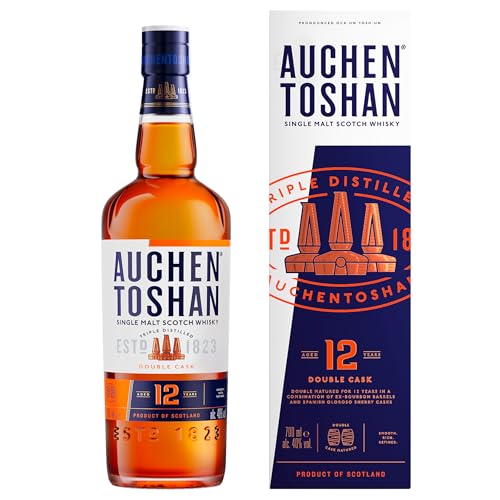
Auchentoshan 12
The gentlest malt on this list, currently approx. €22. Auchentoshan is one of the few Scottish distilleries that distils three times, which makes the spirit noticeably softer. On the nose citrus, vanilla and almond, on the palate caramel, citrus and malt, the finish medium-length and gentle. The flip side: at 40 percent and with this deliberately round style, it has no edge at all. If you are looking for character, this is the wrong bottle.
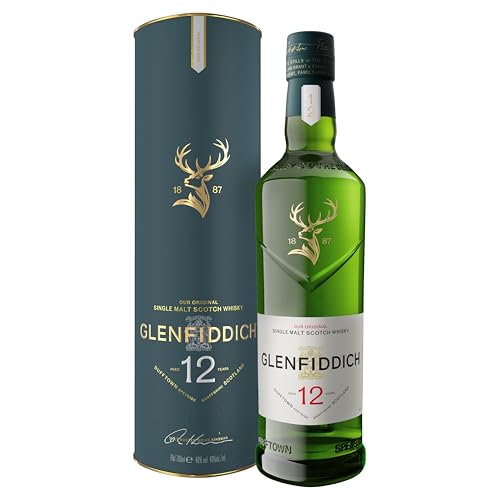
Glenfiddich 12
The best-selling single malt in the world and, for many, the very first bottle. Pear, green apple and malt on the nose, fruity on the palate with pear and delicate oak, the finish medium-length and soft. For approx. €26 you get a very clean Speysider that nobody objects to. That is also exactly the criticism: it is made to please, and experienced drinkers quickly find it too tame.

Glenmorangie The Original 12
The Highland counterpart to Glenfiddich, lighter and distinctly more citrusy. Citrus, orange, ripe peach and mild vanilla on the nose, vanilla, honey, orange and peach on the palate, the finish medium-length with orange and peach. Currently approx. €32. Glenmorangie advertises the tallest stills in Scotland, which explains the light, fruit-led style. At 40 percent it also stays restrained and needs no water.

Highland Park 12
The best compromise on the list and our tip for anyone who wants to dip a toe into smoke. The malt from the Orkney Islands brings heather honey, light smoke and sherry to the nose, honey, malt and gentle peat to the palate, and a medium-length, smoky-sweet finish. Currently approx. €29. Here the smoke is a seasoning, not a statement, which may be too little for peat fans. As a bridge between worlds, hardly any bottle works better.

Balvenie DoubleWood 12
The classic among sherry-finish malts and a very reliable gift whisky. It spends most of its life in a bourbon cask and only moves into a sherry cask at the end. Honey, sherry and vanilla on the nose, honey, dried fruits and spice on the palate, the finish long and warm. Currently approx. €44. Price-wise it sits above comparable Speyside sherry malts without consistently offering more depth. You are also paying for the name here.

Aberlour A'bunadh
The sherry escalation of this list, currently approx. €69. Full cask strength from an oloroso cask, neither chill-filtered nor coloured. Rich sherry, raisin and orange on the nose, intense sherry, dark chocolate and spice on the palate, the finish very long and spicy. Our figure refers to 60.5 percent, and the value varies from batch to batch. Without water it overwhelms unpractised palates, which is worth knowing.

Clynelish 14
The connoisseur's tip on the list and a malt with a texture of its own. Clynelish stands for a waxy, slightly oily character that you will hardly find anywhere else. Wax, citrus and honey on the nose, honey, spicy and lightly salty on the palate, the finish long and waxy. At 46 percent it has the power that the 40-percent malts above lack. A price of approx. €55, however, is no longer an entry-level price, and the style is polarising.

Springbank 10
The only Campbeltown bottle on the list, currently approx. €87. Springbank malts, distils and bottles entirely on site, without chill-filtration and without colouring. Sea salt, light smoke and fruit on the nose, malt, peat and salty-oily on the palate, the finish long and spicy and salty. The price is the honest catch: demand clearly exceeds the small production, and in terms of flavour you can get just as much elsewhere for approx. €87.

Talisker 10
The best smoke entry point at a small price and, at approx. €26, one of the strongest deals in the whole catalogue. Peat smoke, sea salt and citrus on the nose, smoky with black pepper and a sweet malt note on the palate, the finish long, peppery and warm. At 45.8 percent it has noticeably more punch than the standard 40-percent malts. If you fundamentally dislike smoke, you will not be converted here either.

Lagavulin 16
The benchmark for peated Islay whisky and the malt against which all others have to be measured. Dense peat smoke, sherry and seaweed on the nose, bold smoke, dried fruits and sweetness on the palate, the finish very long, smoky and spicy. Currently approx. €54. It is not a beginner's whisky, nor a bottle to drink on the side: if you try it without preparation, you mostly taste smoke and miss the sweetness underneath.
What single malt really means
The word single refers to the distillery, not the cask. A single malt Scotch is a whisky from a single distillery, made exclusively from malted barley, distilled in copper pot stills and matured in oak casks in Scotland for at least three years. Even so, the bottle almost always contains dozens of different casks, which the master blender combines into a consistent house style. Only with a single cask does the contents actually come from one cask.
The opposite pole is blended Scotch, which mixes malt whisky from several distilleries with grain whisky and accounts for around ninety percent of worldwide Scotch sales. Which category makes more sense for you, and why more expensive does not automatically mean better, is explained in our guide Single malt versus blend.
Important for your buying decision: single malt is a production term, not a quality seal. A carefully made blend can taste better than a carelessly bottled malt. And the age statement on the label always names the youngest drop in the bottle, not the average. What lies behind bottlings with no year on them at all is explained in our guide NAS versus age statement.
The six regions at a glance
Scotland officially divides its whisky into six regions. The division has grown historically and is geographical, not based on flavour, but it is still a usable first orientation. With around 50 distilleries, Speyside is the most densely populated region in the world and stands for malty, fruity and sherried malts. The Highlands are the largest region by area and accordingly the most varied: everything from light and floral to robust and spicy is represented.
Islay is the most famous island in the whisky world and, with around a dozen distilleries, the home of heavy peat smoke. The remaining islands, from Skye to Orkney, are grouped as the Islands and often deliver maritime, salty-smoky malts. Campbeltown was once the whisky capital of Scotland, and today only three active distilleries operate there. The Lowlands, finally, long stood for mild, sometimes triple-distilled whiskies and have been experiencing a wave of new distilleries for some years.
You will find the whole map, with history and style characteristics, in our guide to the whisky regions of Scotland. If you want to go deeper into a single region, there are separate buying guides to the best Speyside whiskies, the best Highland whiskies and the best Islay whiskies.
| Region | Typical style | Example from this list |
|---|---|---|
| Speyside | malty, fruity, often sherried | Glenfiddich 12 |
| Highlands | very broad, from floral to spicy | Clynelish 14 |
| Islay | peat smoke, iodine, maritime | Lagavulin 16 |
| Islands | salty, often lightly to moderately smoky | Talisker 10 |
| Campbeltown | salty-oily, spicy, distinctive | Springbank 10 |
| Lowlands | mild, light, sometimes triple-distilled | Auchentoshan 12 |
The assignment describes the typical regional style. Exceptions are common: on Islay there are unpeated malts such as Bunnahabhain 12, and in the Highlands you will find both the light Dalwhinnie 15 and the much more robust Oban 14.
More important than the region: the flavour profile
If you want to buy with intent, pay less attention to the region and more to the flavour profile. Four profiles cover the bulk of all single malts. Fruity and light means pale casks, mostly former bourbon casks of American oak, which give off vanilla, honey, pear and citrus. Glenfiddich 12, Glenlivet 12 and Auchentoshan 12 stand for it.
Sherry-sweet means maturation or finishing in former sherry casks of European oak. They bring raisin, dried fruit, nut and dark spice. The Balvenie DoubleWood 12 shows the mild variant, the Aberlour A'bunadh the uncompromising one. We have collected a whole list on this in the best sherry cask whiskies.
Spicy and robust stands for malts with structure and usually a higher bottling strength, such as the Clynelish 14 or the Springbank 10. Smoky and peaty, finally, is the profile that divides opinion: the peat smoke comes from drying the barley over peat fires, not from the cask. If that appeals to you, our guide leads on to the best smoky whiskies. If you want to deliberately avoid smoke, the list of the best whiskies without smoke will help.
What a good single malt should cost
The honest price range for a very good single malt is lower than many assume. Between €30 and €50 you will find practically everything you need to start and for many years afterwards. The Talisker 10 for approx. €26 and the cask-strength Glenfarclas 105 for approx. €63 are proof that great experiences do not have to cost three figures. You will find a whole selection in this range in the best whiskies under 50 euros.
Above €70 you increasingly pay for age, scarcity and brand value, not necessarily for more flavour. That is not a criticism of expensive bottles but a question of expectations: the Macallan Double Cask 12 is a very good whisky, but it is not twice as good as a sherry malt that costs half as much. If you are looking in this segment, you will find what you need among the best whiskies under 100 euros.
Two levers give you more for your money than a higher age statement. First, bottling strength: malts at 46 percent and above are usually neither chill-filtered nor coloured and feel denser. Second, the type of cask, which supplies most of the aroma. We explain both in detail in the guides to cask strength and to cask types.
Conclusion: which single malt suits you?
If you are just starting out, reach for the Glenfiddich 12 or Glenmorangie The Original 12. They cost approx. €26 and approx. €32 respectively and do nothing wrong. If you want to start even milder, the Auchentoshan 12 at approx. €22 is the gentlest option on the list. Further starter bottles are collected in our guide to the best whiskies for beginners.
If you are after smoke, the Talisker 10 is the cheapest sensible entry point and the Lagavulin 16 the destination of the journey. For everyone caught between the two worlds, the Highland Park 12 remains the smartest choice. As a gift, the Balvenie DoubleWood 12 and the Lagavulin 16 work most reliably, and more ideas are in the guide Whisky as a gift.
The current guide price is given with every recommendation. Good single malt is not an expensive hobby but a question of choosing the right bottle. If you are unsure which profile suits you, our Whisky Finder leads you to suitable suggestions in a few steps. You can set two candidates directly against each other in the whisky comparison, and you will find all Scottish bottlings bundled in the Scotch whisky category.
Related guides
Transparency note: This guide was created with AI assistance and reviewed by our editors before publication. All recommended bottles come from our real catalogue, and prices are guide values. The product photos are not AI images. How we use AI